Posted: Sat Mar 12, 2011 11:48 am
9-11-01 and now Japan has lost more lives on 3-10-11. Add them up and you get 12-21-12. But hey, I'm just fanning the flames.
SG Broadband Community. Everything you'd like to know about Cable Modems, DSL, Satellite, Networking, Security, Wireless, Routers and more.
https://speedguide.net/forums/
De Plano wrote:Just North of here three folks went down to take pictures of the tsunami and were sucked out to sea when they were surpriised by a large wave. Two made it out but one drowned. So they went to take pictures of a tsunami and were surprised by a large wave...... brilliant
JawZ wrote:9-11-01 and now Japan has lost more lives on 3-10-11. Add them up and you get 12-21-12. But hey, I'm just fanning the flames.

Mad_Haggis wrote:they always come in 3's?
Christchurch/NZ so many days ago
Tokyo/JN 2 days ago
Anybody know a good "Beach Boys" tune?
http://www.cbsnews.com/stories/2011/03/ ... a;morenews(Space.com)
The massive earthquake that struck northeast Japan Friday (March 11) has shortened the length Earth's day by a fraction and shifted how the planet's mass is distributed.
A new analysis of the 8.9-magnitude earthquake in Japan has found that the intense temblor has accelerated Earth's spin, shortening the length of the 24-hour day by 1.8 microseconds, according to geophysicist Richard Gross at NASA's Jet Propulsion Laboratory in Pasadena, Calif.
Gross refined his estimates of the Japan quake's impact - which previously suggested a 1.6-microsecond shortening of the day - based on new data on how much the fault that triggered the earthquake slipped to redistribute the planet's mass. A microsecond is a millionth of a second.
"By changing the distribution of the Earth's mass, the Japanese earthquake should have caused the Earth to rotate a bit faster, shortening the length of the day by about 1.8 microseconds," Gross told SPACE.com in an e-mail. More refinements are possible as new information on the earthquake comes to light, he added.
http://www.cbsnews.com/stories/2011/03/ ... ?tag=stackPerhaps the most dangerous fault line in the United States stretches from the northern part of California, up along the coast of Oregon and Washington, and into Canadian waters. It's called Cascadia, and for a long time no one knew it was there.
It wasn't until the mid-1980s that geophysics recognized the fault line that existed just 40 miles offshore -- one frighteningly similar to the one which just erupted off the coast of Japan. It then took until 1995 before the state of Oregon incorporated specific provisions in its building code mandating protection against earthquakes. Many of the buildings now standing in the state were built before the provisions were adopted; the vast majority has not been retrofitted to improve safety.
If, as in the 9.0 magnitude event in Japan, one tectonic plate in Cascadia gets forced beneath another, it could result in a quake that reduces many of the buildings near the coast to rubble. It would take less than 30 minutes for the subsequent tsunami to reach shore.
The last major earthquake to hit in the region was in the year 1700; its effects could be felt all the way across the Pacific Ocean. With the region experiencing 41 quakes 8.0 magnitude or above over the past 10,000 years, geologists say it's a question of when - not if - the next one hits.
"We're overdue," warns geotechnical engineer Yumei Wang of the Oregon Department of Geology and Mineral Industries.

A 7.4-magnitude earthquake struck Japan on Thursday, triggering a tsunami warning for one prefecture.
Workers evacuated the Fukushima Daiichi nuclear plant following the quake, the Tokyo Electric Power Co. said. Tokyo Electric said it has communication with the plant and the power is still on. There were no immediate reports of damage, it said.
The quake's epicenter was off the coast of Miyagi in northeastern Japan, the Japan Meteorological Agency said.
Public broadcaster NHK reported a tsunami warning for Miyagi prefecture, saying people in that area should evacuate away from the shore to a safe place.
NHK also reported a tsunami advisory for Iwate prefecture, saying a tsunami is expected to arrive in coastal regions there as well.
The Pacific Tsunami Warning Center said based on all available data, "a destructive Pacific-wide tsunami is not expected and there is not a tsunami threat to Hawaii."
The U.S. Geological Survey said the quake was centered 41 miles (66 kilomemeters) from Sendai -- one of the areas worst hit by last month's 9.0-magnitude quake -- and 73 miles (118 kilometers) from Fukushima, where a crisis has been under way at the nuclear plant since last month's tsunami.
The quake was centered 207 miles (333 kilometers) from Tokyo, the U.S. Geological Survey said.
It was 15.9 miles (25.6 kilometers) deep, the agency reported.
It took place shortly after 11:30 p.m. local time (10:30 a.m. ET)
With all that we know now, and the USGS is taking this very seriously, this may be a foreshock rather than an aftershock.YeOldeStonecat wrote:Sad...but after such a big quake just happened....smaller aftershocks usually happen. Seems to be not that big of a deal though, power out for a bit, Tsunami warnings but nothing really came out of it.
JawZ wrote:With all that we know now, and the USGS is taking this very seriously, this may be a foreshock rather than an aftershock.
http://en.wikipedia.org/wiki/Foreshock
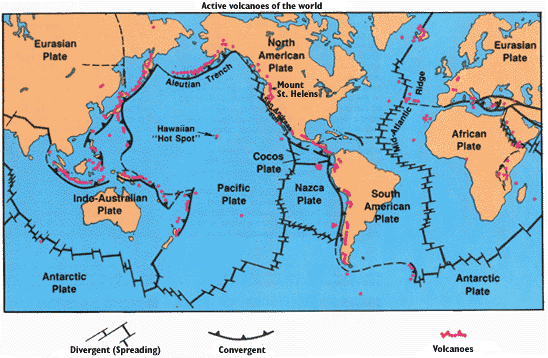
Most of the catastrophic events in the Pacific rim have been preceded by foreshocks. The 2004 Indian Ocean quake was preceded by a major foreshock in 2002. The recent Japan quake was also preceded by multiple foreshocks. Foreshocks are a good thing because they can be used to help predict a main shock event. We've moved from detection to prediction. But being that we're talking about plates shifting, we have to analyze the total fault line which means Hawaii and the Pac coast are now in greater danger of a significant event. The stress load created by the recent quake has placed a greater load on the fault that would affect Tokyo. The whole Rim of Fire is moving in a clockwise direction.
Sava700 wrote:Yep, I don't think people are taking these recent event's seriously and preparing for the worse that could happen in the near future.
Yup, if you go back to the quake originally in chile and watch the major ones after that (nz, jpn)you can see the clockwise movement of these quakes..going by the recent acitivity the past few weeks ramping up in alaska and california, coast of south america as well as yellow stone..we should be in for a treat cant wait.JawZ wrote:With all that we know now, and the USGS is taking this very seriously, this may be a foreshock rather than an aftershock.
http://en.wikipedia.org/wiki/Foreshock
Most of the catastrophic events in the Pacific rim have been preceded by foreshocks. The 2004 Indian Ocean quake was preceded by a major foreshock in 2002. The recent Japan quake was also preceded by multiple foreshocks. Foreshocks are a good thing because they can be used to help predict a main shock event. We've moved from detection to prediction. But being that we're talking about plates shifting, we have to analyze the total fault line which means Hawaii and the Pac coast are now in greater danger of a significant event. The stress load created by the recent quake has placed a greater load on the fault that would affect Tokyo. The whole Rim of Fire is moving in a clockwise direction.
Sava700 wrote:Yep, I don't think people are taking these recent event's seriously and preparing for the worse that could happen in the near future.
http://news.blogs.cnn.com/2011/04/30/st ... ma/?hpt=T2Vanessa del Leon, who works at a hotel in David, said she felt the quake, whose epicenter was 110 miles south of the city.
"Everyone started screaming. We heard a lot of things breaking and computer keyboards smashing on the floor," she said. "This hotel has eight floors and it swayed like a palm tree."
The USGS had said the quake was a magnitude 6.1, but later revised it to 6.0. It hit at 3:19 a.m. local time, according to the USGS.
frostybear wrote:just had 2 5.8 in the alaska region http://earthquake.usgs.gov/earthquakes/ ... 088513.php
.
YeOldeStonecat wrote:Link points to one that happened way back on "Saturday, January 24, 2009" ?
http://www.cnn.com/2011/WORLD/europe/05 ... tml?hpt=T2Thousands of residents of the southeastern Spanish city of Lorca slept outside Wednesday night, hours after the city of about 80,000 was struck by an earthquake that killed eight people, state radio reported, citing authorities.
"It was a strange sensation," said a press office worker who was in his office in the regional capital of Murcia, about 60 kilometers (37 miles) from Lorca. He estimated the duration of the quake from five to eight seconds.
The 5.3-magnitude quake occurred at 4:47 p.m. (10:47 a.m. ET) and was centered about 50 kilometers (31 miles) southwest of Murcia, near the Mediterranean coast, the U.S. Geological Survey said. That is about 350 kilometers (218 miles) south-southeast of Madrid.
It was preceded at 3:05 p.m. by a 4.5-magnitude temblor centered in the same area, the survey said.
YARDofSTUF wrote:Ya we had a small one, no one would have known if the news didn't report it. lol
WELLINGTON, New Zealand - Strong aftershocks rattled New Zealand's quake-devastated city of Christchurch again Monday, toppling one of the few buildings still standing downtown and sinking thousands of homes into darkness.
Bricks crashed down in the cordoned-off city center, where only workers have tread since it was devastated in February's major earthquake. About 200 people were there when the quakes struck Monday, and two were briefly trapped in a church. More than 40 people have been taken to hospitals with minor injuries from falling debris, the city council said.
"We are being enveloped with dust," Christchurch Mayor Bob Parker told New Zealand's National Radio. "It is very, very scary."
All across the city, people fled buildings in panic when a 5.2-magnitude quake struck during lunchtime; just over an hour later, a 6.0 hit, according to the U.S. Geological Survey. Smaller quakes were also recorded.
Read more: http://www.cbsnews.com/stories/2011/06/ ... z1PAWYndIl
http://www.cnn.com/2011/WORLD/asiapcf/0 ... ?hpt=hp_t2An earthquake with a preliminary magnitude of 6.7 struck off the Pacific Coast of northern Japan early Thursday, Japanese and U.S. seismologists reported.
The Japan Meteorological Agency warned that a tsunami could be generated by the temblor, but canceled the warning less than an hour after the quake.
The coastal cities of Kamaishi and Ofunato ordered about 8,000 households near the coast to evacuate, the Japanese public broadcaster NHK reported, but there was no immediate reports of damage or injuries.
Train service in the area was stopped temporarily, but resumed operation within an hour, NHK reported.
The quake struck shortly before 7 a.m. (6 p.m. Wednesday ET) and was centered 530 kilometers (330 miles) north-northeast of Tokyo.
The epicenter was off the northern prefecture of Iwate, about 175 kilometers (109 miles) north of where the magnitude-9 quake that devastated northern Japan struck in March.
 it is an interesting pattern though
ANCHORAGE, Alaska (Reuters) - A major earthquake of 7.4 magnitude struck in the Pacific Ocean more than 1,000 miles west of Anchorage on Thursday, prompting a brief tsunami warning for part of the remote Aleutian Islands chain.
No damage or injuries were reported. The warning, which extended for roughly 800 miles -- from Unimak Pass, northeast of Dutch Harbor, westward to Amchitka Pass, west of Adak Island -- was canceled after a little more than an hour.
A tsunami wave measuring just 6 centimeters tall was recorded at Nikolski, a tiny Aleut village on the island of Umnak, and a 10-centimeter wave was observed at Adak, said Becki Legatt, a spokeswoman for the West Coast and Alaska Tsunami Warning Center in Palmer, Alaska.
The coast of the entire Alaska peninsula and all of the Alaska mainland were never considered to be threatened.
The quake struck shortly after 7 p.m. local time at a depth of about 25 miles. A second tremor of magnitude 7.2 hit in the same vicinity of the Aleutians a half-minute later, the U.S. Geological Survey said.
Quakes of 7 to 8 magnitudes and higher are relatively common in the Aleutians but are generally of little consequence because the island chain is so remote and sparsely populated.
"This is a very seismically active area," said Randy Baldwin, a USGS geophysicist with the National Earthquake Information Center in Golden, Colorado.
A tsunami warning means all coastal residents in the warning area who are near the beach or in low-lying regions should move immediately to higher ground and away from harbors and inlets, including those sheltered directly from the sea.
(Reporting by Yereth Rosen in Anchorage; Writing by Steve Gorman; Editing by Philip Barbara)
May slide into the ocean next year.. or this year. Nobody really knows but stuff is heating up and happening more often and worse each time!RoundEye wrote:This isn’t good for California, everything west of the San Andreas fault is eventually going to slide into the Pacific ocean, in a million years or so.
http://www.cnn.com/2011/WORLD/asiapcf/0 ... ?hpt=hp_t2A major earthquake struck off Japan's northeastern coast Sunday, prompting tsunami advisories that were later canceled, the Japan Meteorological Agency (JMA) said.
Small tsunamis were observed along the coast, measuring between 10 and 20 centimeters, said the JMA.
There were no immediate reports of injuries or damage, according to the Japanese news agency Kyodo.
The U.S. Geological Survey said the earthquake struck at 10:57 a.m. at the epicenter, about 130 miles east of Sendai.
The earthquake was more than 20 miles deep and had a magnitude of 7.0, the USGS said.
The JMA measured the magnitude of the quake at 7.1.